Articles
ACTINO’s Sustainable, Cost-Effective Approach
When it comes to agricultural inputs, “sustainable” and “affordable” are not always words that go together. Often, eco-friendly products can be more expensive due to novel technology or higher production costs. ACTINO Biosupplement Inc. set out to break that paradigm. By leveraging a bacteria-based solution, ACTINO created a mushroom supplement that is both gentle on the environment and light on cost. Let’s explore how ACTINO achieves this balance and why it matters for the agriculture industry.
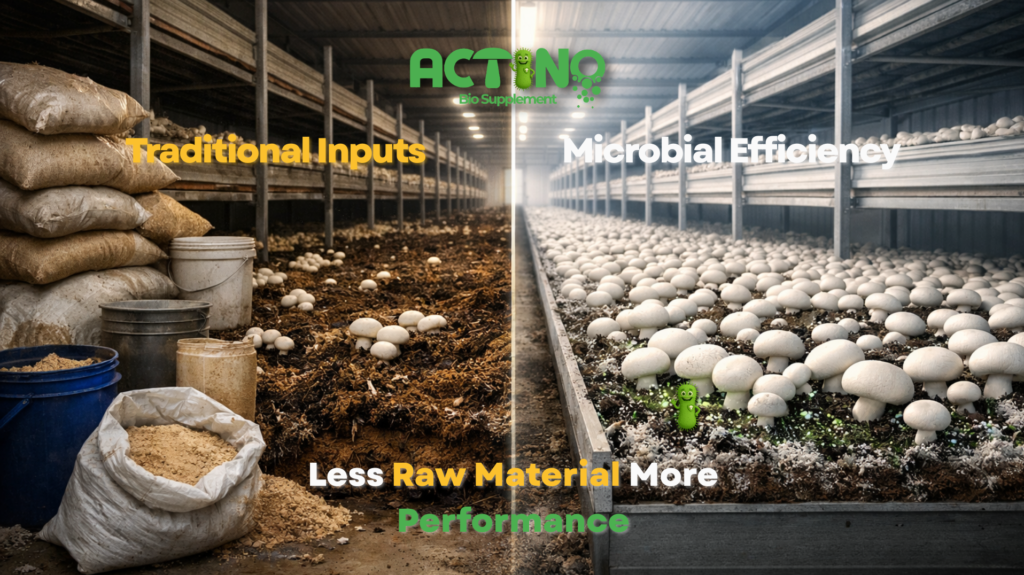
Eliminating Raw Material Waste: Traditional mushroom supplements (and many fertilizers) rely on raw materials – things like mineral nutrients or organic meals that must be sourced, processed, and transported. ACTINO’s approach uses no raw agricultural commodities as the core ingredient of the supplement. The active ingredient is a cultured bacterium. This means ACTINO’s production doesn’t depend on activities like farming soy or mining minerals to create the product. By cutting out these steps, ACTINO reduces the overall resource consumption associated with its product. There’s less land needed (no fields growing raw materials for the supplement) and less processing waste. It’s a more direct line from production to end-use.
Low Cost-of-Goods (COGS): With few to no raw inputs, the cost to produce ACTINO’s supplement is mostly the cost of fermentation (growing bacteria) and formulation. This cost is relatively low, especially once the process is scaled up. The business plan highlights that ACTINO’s low COGS allows it to have an 85% profit margin and still keep prices competitive. That margin provides a cushion to adjust pricing for market entry or bulk deals, meaning ACTINO can be flexible in pricing strategy. Importantly, it indicates that farmers aren’t paying for extraneous costs – the value they pay for is mostly the innovation and effect, not costly ingredients.
Competitive Pricing Strategy: Because of its cost advantage, ACTINO has the ability to price its supplement below the market trend of traditional. This is explicitly one of ACTINO’s competitive strategies: “Eliminating the raw materials brings the ability to maintain the price below the market trend to attract customers For a mushroom grower looking at options, a product that is both innovative and cheaper than established ones is very appealing. It lowers the risk of trying something new if the investment is comparable or less. By passing on savings to customers, ACTINO accelerates adoption and captures market share, while farmers benefit from improved economics on their end (they pay less and potentially earn more from yield increases).
Sustainability and Environmental Footprint: ACTINO’s supplement supports sustainability in a couple of ways. First, as mentioned, it doesn’t require sourcing of additional nutrients, some of which (like certain fertilizers) can have a high carbon footprint to produce. Second, by improving yield and efficiency, it helps produce more food (mushrooms) per input unit, which is a core principle of sustainable agriculture – higher output with equal or fewer inputs. Third, since it doesn’t introduce excess nutrients into the environment, it avoids problems like nutrient runoff or the need to dispose of nutrient-rich waste after the crop. The bacteria in ACTINO are naturally occurring types that work in harmony with the crop, meaning once the crop is harvested, there isn’t a load of chemical residue left behind. This bodes well for soil health and for the safety of workers handling the supplement.
No Seasonal or Usage Constraints: Another aspect of cost-effectiveness is that ACTINO has no restrictions in using the supplement year-round. Some supplements or treatments can only be used in specific conditions or might have downtime (for example, certain biocontrols might not work in cold weather). ACTINO can be used in any cropping cycle continuously, which means the equipment or setup a farm invests in to apply ACTINO (e.g., mixing systems, sprayers, etc.) is utilized fully, increasing its value. The supplement can be part of every crop rotation, providing continuous benefit without needing alternate products seasonally.
Efficiency = Savings: By improving operational efficiency for growers (shorter cycles, less contamination, etc., as discussed in Post 17), ACTINO indirectly saves costs for farmers as well. Fewer lost crops and faster time to market improve a farm’s bottom line. So, not only is the product itself cost-effective to buy, it also contributes to cost savings in the cultivation process. This double advantage strengthens the economic case for ACTINO in a farm’s sustainability plan. In summary, ACTINO’s sustainable and cost-effective approach is a standout feature in agri-tech. The company has proven that cutting-edge biotech solutions don’t have to come with prohibitive costs or environmental trade-offs. By eliminating raw material inputs and focusing on efficient bacterial production, ACTINO keeps its own costs low and passes those savings to customers. This strategy helps encourage adoption of a sustainable practice (since farmers are more likely to adopt something that’s affordable), creating a positive feedback loop: sustainability drives cost savings, which drives more sustainability. It’s a model example of how innovation can align the interests of business, customers, and the environment all at once.
#Sustainability #CostSavings #GreenTech #AgInnovation #AffordableAg #OrganicFarming #کشاورزی_پایدار# مقرون_به_صرفه# نوآوری_سبز #ACTINO #هزینه_کم# سازگار_با_محیط_زیست