Articles
Bacterial vs Nutrient Supplements – The ACTINO Difference
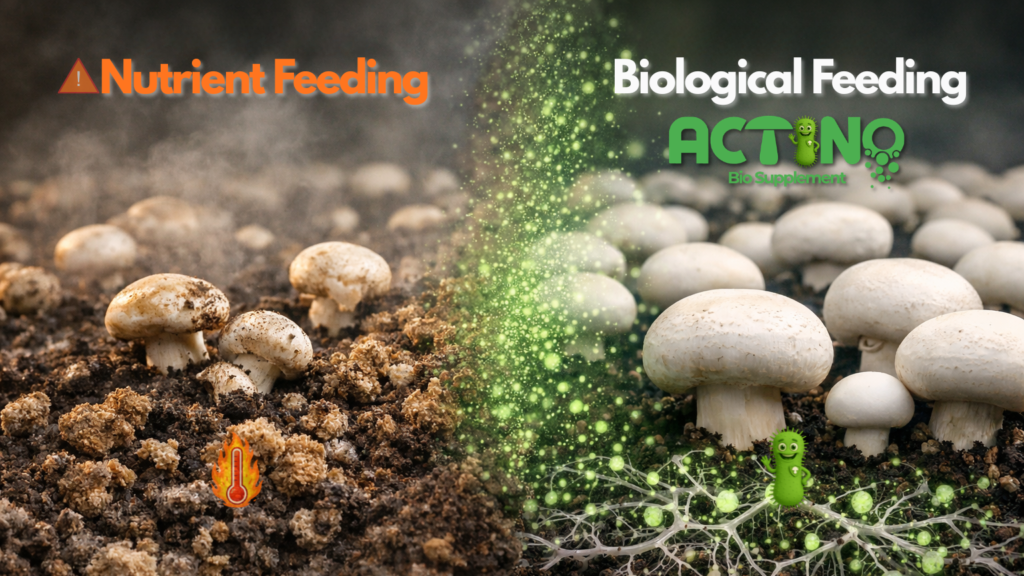
In the realm of mushroom cultivation, most yield-improvement supplements on the market have historically followed a similar playbook: add more nutrients to the mushroom’s growing medium (compost or substrate) to feed the crop. These could be protein-rich meals (like soy or feather meal) or other nutritional additives that mushrooms can use to grow larger and faster. ACTINO Biosupplement Inc. turned this idea on its head by asking a simple question: what if, instead of adding more food for the mushrooms, we helped mushrooms eat the food that’s already there, more efficiently?
This question led to ACTINO’s defining innovation – a bacterial-based supplement that does not contain conventional nutrient additives at all. ACTINO’s supplement contains a special bacterium that helps mushrooms absorb more nutrients from the existing substrate. In other words, it doesn’t make the substrate richer by itself; it makes the mushroom better at feeding. This is a fundamentally different mechanism of action compared to nutrient supplements.
Let’s break down the differences and why they matter:
- Nutrient Supplements (Traditional): These are typically formulated with materials like proteins (soy, corn gluten, feather meal, etc.) and minerals. When added to mushroom compost, they indeed can increase yield because they provide extra nutrition for the mushrooms. However, they also have downsides. Adding these nutrients often raises the microbial activity and heat in the substrate, because other organisms (like competitor molds or bacteria) start consuming them too. Growers have to be careful; too much nutrient can cause overheating or contamination outbreaks in the crop. Additionally, sourcing and preparing these nutrient mixes involve costs and logistics (raw materials have to be grown or processed, like soy meal).
- ACTINO’s Bacterial Supplement: ACTINO introduces beneficial bacteria into the system. These bacteria effectively “unlock” the nutrients already present in the compost, making them more available to the mushroom mycelium. Mushrooms often leave a significant portion of substrate nutrients unutilized; ACTINO’s bacteria address that inefficiency. By colonizing the substrate alongside the mushroom, the bacteria may produce enzymes or other biochemical changes that free up nutrients or stimulate the mushroom’s own uptake mechanisms. This approach means no external nutrient is added – so the substrate’s balance isn’t heavily altered. As a result, issues like temperature spikes or contamination risk from excess nutrients are mitigated. It’s a cleaner, more biological solution.
- Elimination of Raw Materials: Because ACTINO’s method doesn’t rely on adding feedstock like soy or other meals, it eliminates the cost and complexity of those raw materials. Traditional supplements essentially carry a cost of goods (the nutrients themselves), whereas a bacterial culture can be grown relatively cheaply in a fermentation tank using basic ingredients. ACTINO capitalizes on this – their supplement can be produced without the need for expensive raw nutrient inputs, which in turn allows them to offer it at a competitive price while maintaining good margins. This is a significant economic advantage.
- Scientific and Sustainable Edge: The ACTINO approach is deeply rooted in microbiological innovation. It reflects a trend in agriculture of using live microbes (biostimulants, biofertilizers) to enhance plant growth, rather than chemical fertilizers. It’s more sustainable because it works with existing resources. As ACTINO’s business plan notes, focusing on bacterial solutions “eliminates the cost of raw materials” and supports sustainable agricultural development. It’s also scientifically exciting – proving that harnessing the right bacteria can improve yields by a notable percentage (initially about 15% in trials, and even higher in later tests).
- Competitive Advantage: When comparing ACTINO to nutrient-based competitors (for example, a company like Nutrigain which makes nutrient supplements for mushrooms), this difference is stark. Nutrigain’s product adds nutrients, whereas ACTINO’s adds a microbe. As the ACTINO team highlighted when meeting with Nutrigain, this unique bacterial basis is ACTINO’s competitive advantage. It’s the first of its kind in the market – making ACTINO not just another supplement, but a new category of supplement.
In summary, ACTINO’s bacterial supplement represents a paradigm shift for mushroom growers. Instead of the older method of “feeding the crop more,” it’s about “helping the crop feed itself better.” This means less risk of contamination, no extra raw materials, and a focus on biological synergy between mushrooms and beneficial bacteria. The result is a more sustainable way to boost production. It’s a classic example of working smarter, not harder: leverage the unseen helpers (microbes) to get more out of what’s already present, rather than simply piling on more inputs. This ACTINO difference is driving interest and adoption, as it promises growers a simpler, safer means to increase yields – and it exemplifies how innovation in biotechnology can redefine agricultural practices.
#Biotech #MicrobialInnovation #CompetitiveAdvantage #MushroomFarming #Sustainability #مکمل_باکتریایی #نوآوری #رشد_قارچ #ACTINO #زیست_فناوری #کشاورزی_پایدار